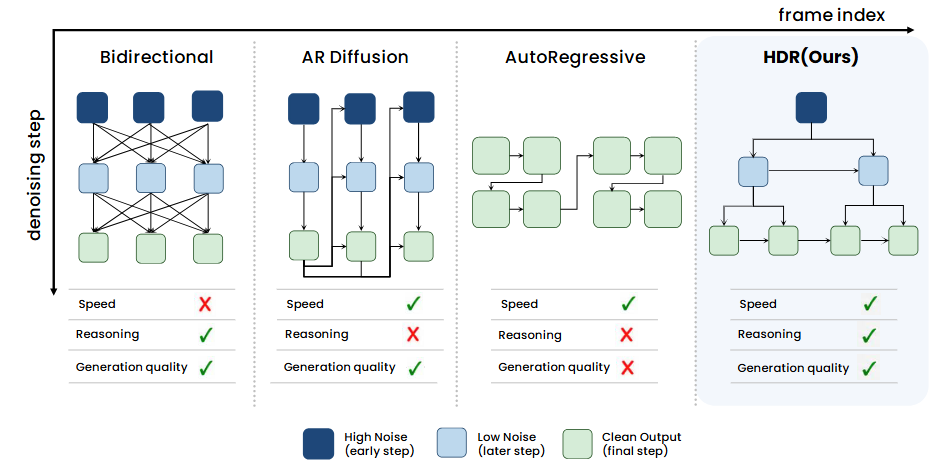
Video models are recently evolving into vision foundation models, but they still lack human-like, multi-step reasoning. Existing streaming autoregressive diffusion models are efficient but lack the reasoning ability, whereas bidirectional diffusion allows for global revision but incurs high inference cost due to the dense frames in fixed-sequence denoising. Consequently, both paradigms struggle to maintain logical consistency with low-latency streaming in complex reasoning tasks.
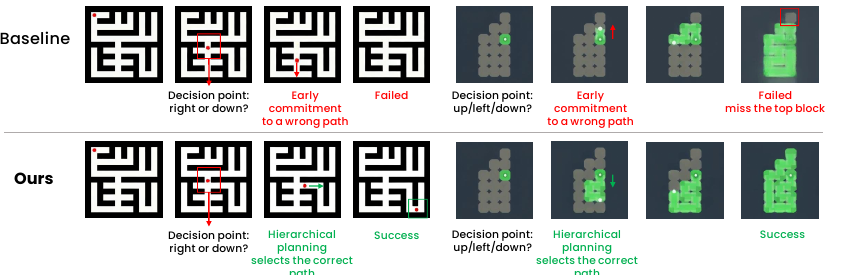
Bridging this gap, we propose HDR (Hierarchical Denoising for Visual Reasoning), a unified framework for multi-step reasoning by integrating hierarchical latents into the causal video generation process. HDR organizes video latents into a tree-structured hierarchy to perform coarse-to-fine reasoning before streaming output. Coarse denoising layers maintain uncertain hypotheses for global planning, while finer denoising layers progressively refine them into concrete visual states. A sparse hierarchical attention pattern further reduces temporal attention cost.
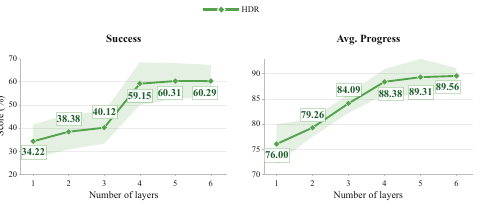
We construct a level-stratified multi-step video reasoning benchmark with out-of-distribution cases, covering six tasks: maze navigation, Tower of Hanoi, one-line drawing, sliding puzzle, Sokoban, and water pouring. Compared with the streaming autoregressive diffusion baseline, HDR improves overall success from 34.22 to 60.29 and average progress from 76.00 to 89.56, while maintaining low-latency streaming at 0.70s per latent.
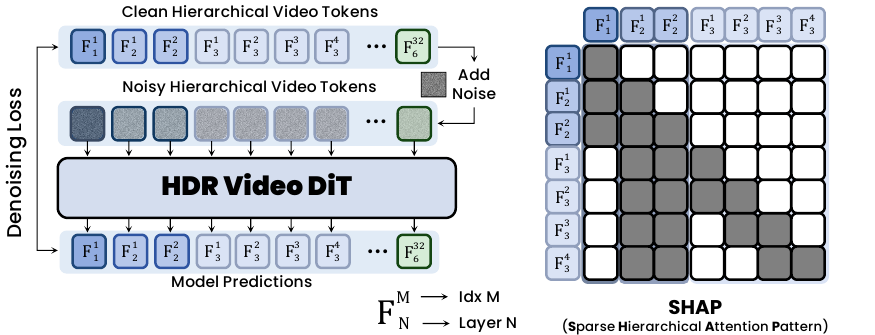
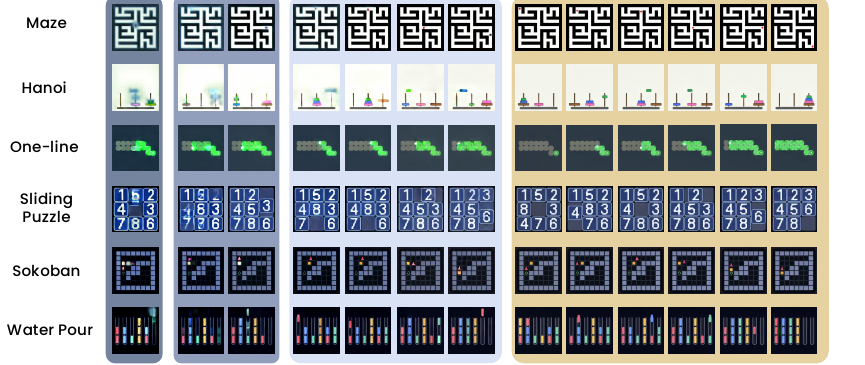
HDR represents video latents as a tree-structured hierarchy across temporal resolutions. During inference, tokens are generated in a coarse-to-fine autoregressive order: upper layers form global hypotheses, lower layers refine those hypotheses into concrete visual states, and the final layer streams the output.
SHAP (Sparse Hierarchical Attention Pattern) lets each token attend only to fixed local, parent-level, and first-frame contexts. This keeps temporal attention sparse while allowing information from coarse planning layers to flow into fine visual generation through a shared KV cache.
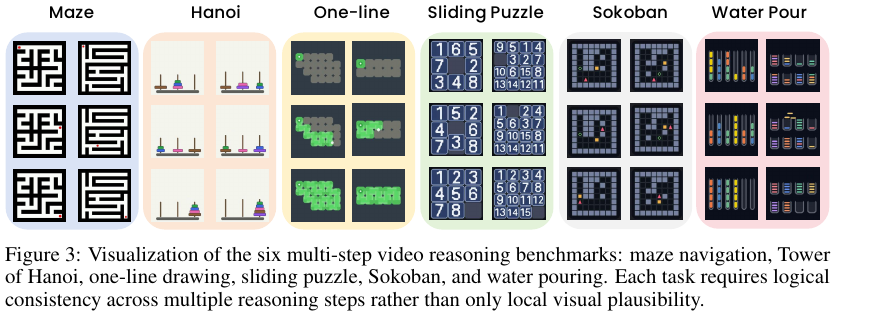
The benchmark covers six long-horizon reasoning tasks that require logical consistency across generated trajectories rather than only local visual plausibility: maze navigation, Tower of Hanoi, one-line drawing, sliding puzzle, Sokoban, and water pouring.
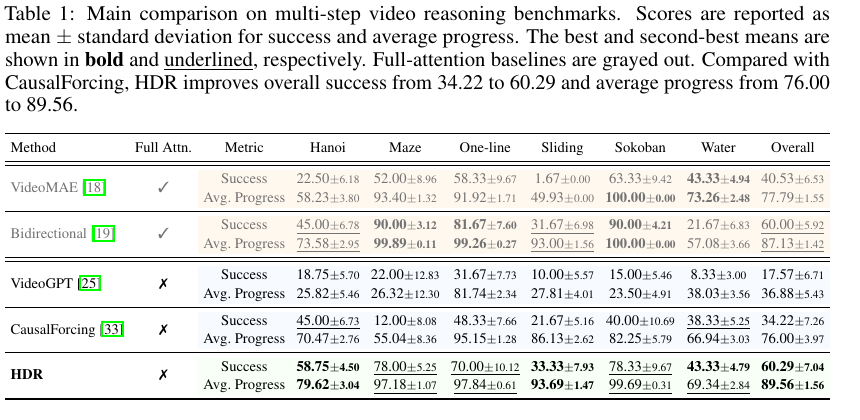
HDR achieves the best overall success and average progress among compared methods while retaining the low-latency streaming behavior of autoregressive diffusion.
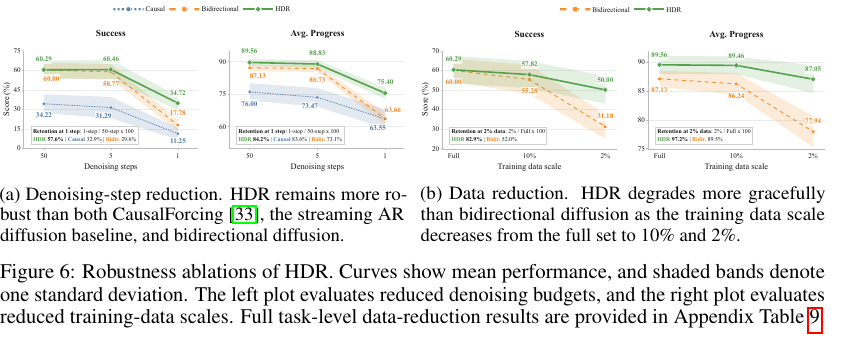
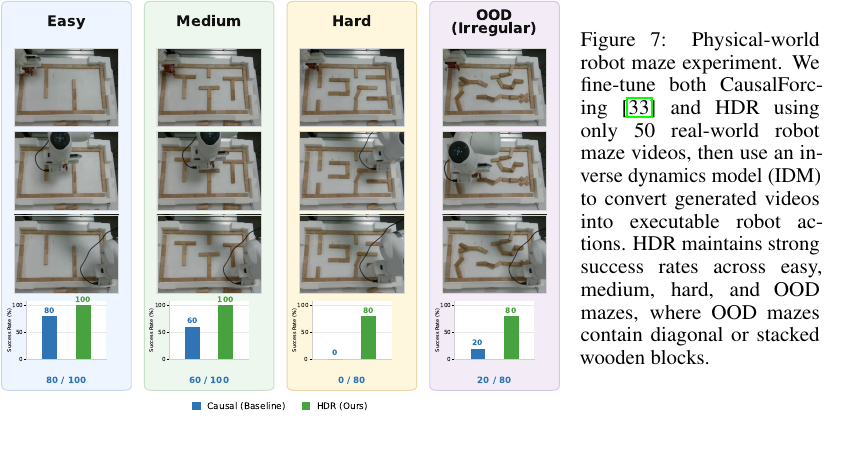
The hierarchy improves robustness under reduced denoising budgets and limited training data. In physical-world maze experiments, HDR also transfers to robot interaction after fine-tuning on 50 real-world robot maze videos.
L1 · 1 latent
A hard maze case visualizes HDR's tree-structured hierarchy: coarse levels summarize long-range planning, and lower levels expose increasingly dense latent states before final streaming output.
Front view
Left view
Right view
Maze 022
Maze 020
Maze 054
Maze 041
Maze 023
Hanoi 103
Hanoi 099
Hanoi 066
Hanoi 091
Hanoi 113
One-line 164
One-line 173
One-line 186
One-line 189
One-line 188
Sliding 200
Sliding 195
Sliding 235
Sliding 214
Sliding 242
Sokoban 258
Sokoban 255
Sokoban 301
Sokoban 275
Sokoban 265
Water 343
Water 330
Water 338
Water 315
Water 344